Ping · Drivers
Ping G430 LST Driver
0 reviews analyzed
4.6/5 avg rating
Source: pluggedingolf.com
Overview
When PING launched the G430 driver family in January 2023, they offered three head designs: the G430 MAX for maximum forgiveness, the G430 SFT for slice correction, and the G430 LST for low-spin performance. Among serious golfers and club fitters, the LST quickly became the most talked-about of the three — for good reason.
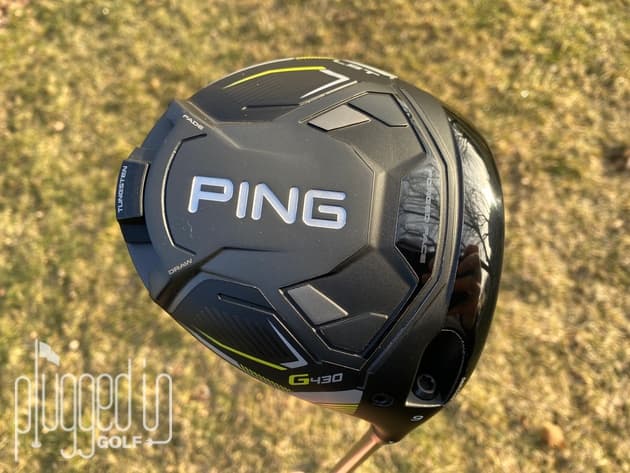
The G430 LST introduces two technologies new to PING's driver lineup: Carbonfly Wrap, a structural carbon fiber application that replaces steel on portions of the crown, and a reconfigured 22-gram rear movable weight that shifts ball flight left or right by up to 7 yards. Together, these innovations allow the LST to reduce spin by 200-400 RPM compared to the G430 MAX without the catastrophic forgiveness penalty that plagues many low-spin drivers.
Plugged In Golf's head-to-head testing confirmed what fitters across the country reported: "What I've always found impressive about PING's low-spin drivers is that they don't sacrifice much in terms of forgiveness." Ball speed measurements showed the LST giving up "almost nothing" to the MAX on center contact, while delivering meaningfully less spin for faster swingers. The result is one of the most compelling driver upgrades of the 2023 equipment cycle.
Released at $549.99 MSRP, the G430 LST now trades around $449-$499 following the G440's 2024 launch, making it an outstanding value in the mid-range driver tier.
Score Breakdown
Our aggregate analysis gives the PING G430 LST Driver an overall score of 8.6/10. Here's how it breaks down:
What People Love
Genuine, measurable spin reduction. The G430 LST's most compelling feature is its ability to do what it promises. In fitting sessions reported on GolfWRX and Reddit, players with driver swing speeds of 90-105 mph consistently see 200-400 RPM less spin vs. the G430 MAX. At those spin levels, that translates to 10-20 yards of additional carry. One Amazon reviewer reported going from 3,100 to 2,700 RPM after fitting, gaining 15-18 yards per drive.
Exceptional adjustability. The G430 LST features PING's 8-position hosel — capable of modifying loft, face angle, and lie angle in a single adjustment — combined with the 22g rear movable weight that shifts shot shape. This level of adjustability exceeds many competitors and gives fitters the tools to dial in the LST perfectly for each golfer's swing characteristics.
Preserved ball speed. The common criticism of low-spin drivers is that they make heel and toe strikes even worse. PING's engineering largely avoids this trap. In side-by-side testing, ball speed comparisons between LST and MAX are nearly identical on center strikes, and while the LST does show slightly wider dispersion on mishits, the difference is more manageable than with competitors' low-spin options.
Carbonfly Wrap aesthetics and function. The strategic carbon fiber application on the crown is the first of its kind for PING in recent years. Beyond the visual distinction from the G430 MAX, it serves a weight-savings function that allows PING to redistribute mass for better CG placement. The matte black crown with the Carbonfly texture has received consistent praise from reviewers for its clean, purposeful look.
What People Hate
Compact footprint creates anxiety at address. The G430 LST is noticeably smaller from front to back than the G430 MAX, and for golfers accustomed to large 460cc heads, the visual difference at address can be disconcerting. Multiple reviewers noted they needed several rounds to feel comfortable. This is normal for any low-spin driver with a CG-optimized footprint, but golfers who rely on a large head for confidence should test carefully before buying.
Slightly louder impact sound. While significantly quieter than the G425 LST, the G430 LST produces a bit more "pop" on center impact compared to the G430 MAX. Plugged In Golf's reviewer noted this was minor but detectable. Golfers who prefer the muted impact sound of the G430 MAX may find the LST's feedback less satisfying.
Limited shelf presence post-G440. With the G440 LST driver arriving in 2024, the G430 LST has moved to clearance pricing at many retailers. While this is great for value-seekers, it does mean fewer fitting options and potentially limited stock shaft availability at some locations.
Competitors
TaylorMade Stealth 2 LS Driver (~$449): TaylorMade's carbon fiber face technology delivers exceptional ball speeds, and the Stealth 2 LS competes closely with the G430 LST on spin numbers. In fitting comparisons, fitters report the two drivers often trade head-to-head, with the G430 LST winning on dispersion and the Stealth 2 LS sometimes winning on raw distance for higher swing speed players. Both should be in any low-spin driver fitting.
Callaway Rogue ST LS Driver (~$399-$449): Callaway's low-spin model uses jailbreak internal architecture for high ball speeds. The Rogue ST LS tends to produce comparable distance numbers but slightly higher spin than the G430 LST. For players who need maximum spin reduction, the PING edges it out. For players where value is the primary concern, the Rogue ST LS is compelling.
PING G430 MAX 10K (~$449): PING's own G430 MAX 10K driver uses a 10,000 RPM spin reduction technology while maintaining the large 460cc footprint. For golfers who want lower spin without the compact footprint anxiety of the LST, the MAX 10K is worth comparing side-by-side. In fitter testing, the LST still typically produces lower absolute spin numbers.
Who Should Buy This
The G430 LST is ideal for golfers with driver swing speeds of 90-115 mph whose current driver spin exceeds 2,800 RPM. If Trackman numbers show you're ballooning drives or losing carry distance to excess spin, the LST belongs in your fitting. It's also excellent for better players (6-12 handicap) who want adjustability and workability without sacrificing the forgiveness PING is known for.
Who Should Skip
Golfers with driver swing speeds below 90 mph typically don't generate enough speed to produce excessive spin, and the LST's compact footprint is likely to cause directional issues without the benefit of meaningful spin reduction. The G430 MAX or SFT will produce better results. Similarly, golfers with swing speeds above 115 mph may find the G430 LST's spin reduction insufficient and should look at custom shaft options or more aggressive low-spin heads.
The Bottom Line
The PING G430 LST driver is one of the most complete low-spin driver options of the 2023 generation — and at its current discounted price point around $449, it represents exceptional value for high-ball-speed golfers. The Carbonfly Wrap, movable weight, and 8-position hosel give fitters every tool they need to maximize each player's distance and accuracy.
Our Score: 8.6/10