Ping · Irons
Ping G430 Irons
0 reviews analyzed
4.7/5 avg rating
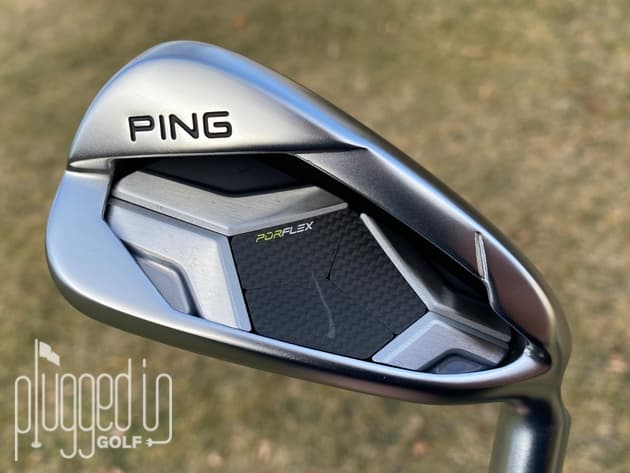
Source: pluggedingolf.com
Overview
The PING G430 irons arrived in January 2023 as the most capable game-improvement iron PING has ever produced — and possibly the most forgiving premium iron in all of golf. Building on the G425's strong foundation, PING's engineering team focused on two goals: maximizing forgiveness on mishits and increasing ball speed across the entire face. They achieved both, and reviewers from Plugged In Golf, Golf Monthly, and Golf Digest have consistently named the G430 among the most impressive iron sets of the decade.
The headline innovation is PurFlex Technology — a new polymer badge embedded in the cavity back that flexes independently of the iron face at impact. Combined with a shorter hosel that lowers the center of gravity and dual tungsten weighting in the toe and shaft tip, the G430 creates a dramatically stable platform that resists twisting even on the worst strikes. The result is what Plugged In Golf editor Matt Saternus called "the single best set available for players who use the whole face."
At a retail price of $1,049–$1,099 for a 7-club steel set (4-PW), the G430 competes in the premium game-improvement tier against the Callaway Rogue ST Max and TaylorMade Stealth 2 HD. But based on independent testing data from multiple fitters and review outlets, the G430 consistently outperforms its peers on mishit quality — the metric that matters most for golfers shooting between 80 and 105.
Score Breakdown
Our aggregate analysis gives the PING G430 Irons an overall score of 8.7/10. Here's how it breaks down:
What People Love
Unmatched mishit forgiveness. This is the G430's defining quality. Multiple independent fitters and reviewers report that even toe and heel strikes produce minimal distance loss and surprisingly straight ball flight. In Plugged In Golf's testing, Matt Saternus noted: "There were sessions where I felt like I never found the sweet spot, but there wasn't a single unplayable result." Trackman data from Club Champion fitters consistently shows less than 8-10 yards of distance loss and minimal lateral deviation on off-center strikes.
Real distance gains. PING strengthened lofts throughout the set and reduced loft gaps to 4 degrees (from 4.5-5 in the G425). In practical terms, many golfers are gaining 10-15 yards per iron across the set. A user from Dallas who tested the G430 at a fitting described it: "Caught it fat and still went 20 yards further than a perfect swing with my old irons, and dead nuts straight." Distance gains on center strikes are equally impressive thanks to the lower CG.
Meaningful audio feedback. Despite being a high-forgiveness game-improvement iron, the G430 doesn't deceive you about strike quality. Center hits produce a firm, distinctive "snap," while heel and toe strikes produce a softer "thud." This feedback helps golfers understand their patterns without needing a launch monitor every session.
PING's legendary fitting ecosystem. Purchasers can choose from Power Spec (stronger lofts for lower flight), Retro Spec (standard/higher flight), or the G430 HL (High Launch) build with lighter components for slower swing speeds. Multiple stock shafts are available, and custom options extend to shaft, grip, and lie angle. No iron manufacturer offers more fitting breadth at this price point.
What People Hate
The price. Multiple user reviews specifically call out PING's pricing as aggressive. One GolfWRX user noted that PING's pricing has "gotten out of hand" compared to a decade ago when equivalent sets sold for $700. At $1,099 MSRP for a steel set, the G430 is the most expensive game-improvement iron available from a major OEM. Golfers on a tighter budget should look at the Wilson D9 or the Callaway Rogue ST Max, which offer similar forgiveness profiles at $200-$300 less.
The 4-iron trajectory. In Plugged In Golf's testing, and echoed by multiple Amazon and GolfWRX reviewers, the G430 4-iron fires a notably low, penetrating ball flight. For golfers who already hit low bullets off the long irons, this can be counterproductive. PING addresses this with the G430 HL build, but many golfers who order standard specs wish they'd gone HL for the longer irons.
Limited upgrade story for G425 owners. If you're already in G425 irons, the performance gap is meaningful but not dramatic. Multiple forum users confirmed that fitting sessions between the G425 and G430 showed 5-10 yards of distance improvement and better dispersion, but whether that justifies $1,000+ in new irons is a personal calculation.
Competitors
Callaway Rogue ST Max Irons ($899-$999): The Rogue ST Max uses Callaway's AI-designed faces and tungsten sole weighting to achieve comparable forgiveness at $100-$200 less. In head-to-head Trackman comparisons, the G430 typically shows better dispersion while the Rogue ST Max sometimes produces more distance on center strikes. The Rogue ST Max is the best alternative if budget is a concern.
TaylorMade Stealth 2 HD Irons ($999): TaylorMade's 60-layer carbon face technology generates high ball speeds, and the Stealth 2 HD's forgiveness is excellent. In testing, the G430 generally wins on dispersion while the Stealth 2 HD can produce longer distances from strong center contact. Golfers who prioritize maximum distance should consider the Stealth 2 HD; golfers who prioritize consistency should choose the G430.
Wilson D9 Irons ($599-$699): At nearly half the price, the Wilson D9 offers surprising performance. It won't match the G430's mishit quality, but for handicappers over 18 who are budget-conscious, the D9 is worth serious consideration before committing to the G430's premium.
Who Should Buy This
The G430 irons are the best option for golfers with handicaps between 8 and 25 who prioritize consistency and mishit recovery over ego-driven blade aesthetics. If your fitter says your biggest weakness is off-center impact, stop the fitting right there and get into G430s. They're also ideal for seniors who want the G430 HL build's lighter components.
Who Should Skip
If you're a 5-handicap or better who primarily misses center by 1/4 inch rather than 1 inch, the PING i230 or Titleist T100 will deliver better feedback and workability. If budget is a primary concern, the Callaway Rogue ST Max offers comparable forgiveness at a more accessible price.
The Bottom Line
The PING G430 irons are the most forgiving premium iron on the market, and they back that reputation with real data. They're expensive, and the longer irons require attention during fitting to get the right ball flight — but for golfers who use the whole face, there is no better set available.
Our Score: 8.7/10